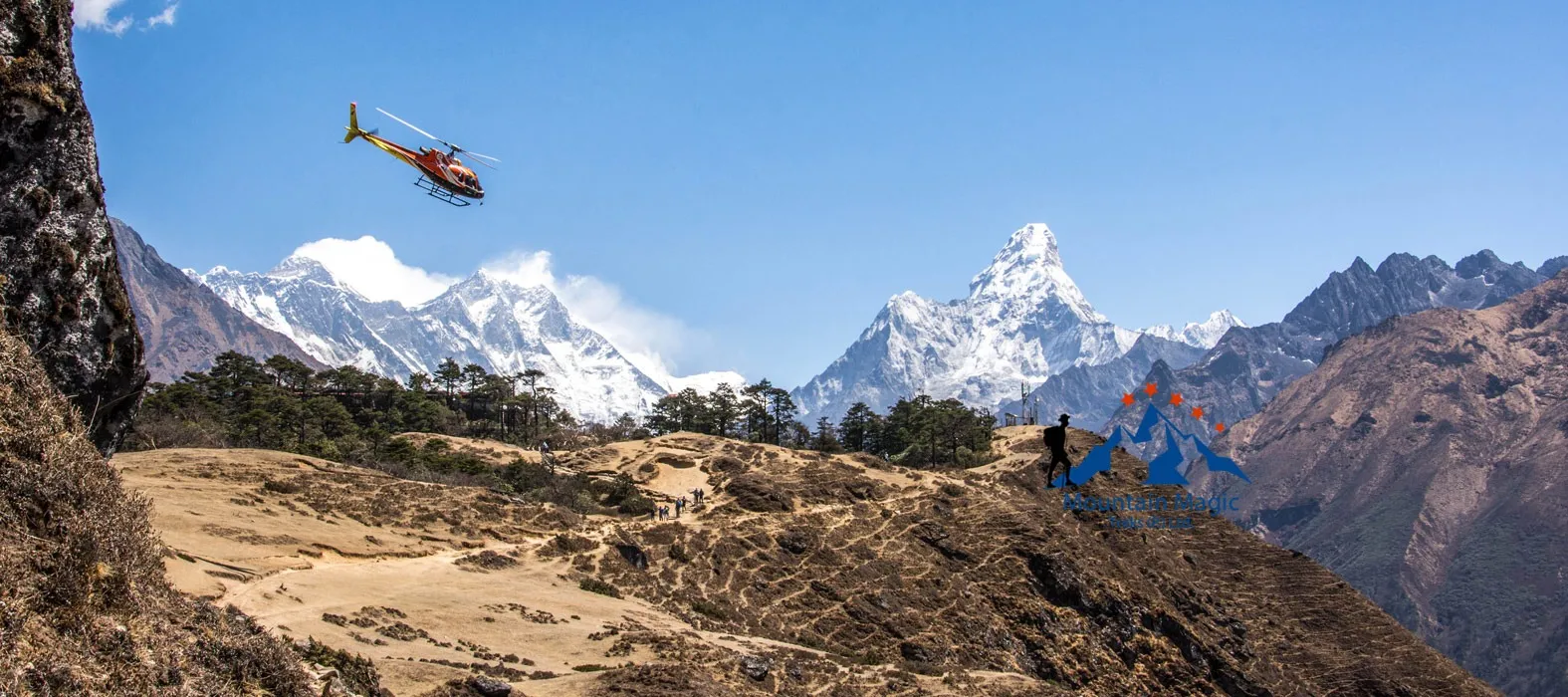
Imagine taking the same trip in two completely different ways.
For most of the journey, you are walking. You notice the stones under your boots, hear rivers below the trail, pass small mountain homes, and stop when your body needs a break.
Then, near the end, everything changes.
You are no longer looking at the Himalayas from the trail. You are looking down from the sky.
That contrast is what makes the Everest Base Camp Trek With Helicopter Return different. The journey combines slow travel through the Khumbu with a fast flight over the mountains at the end. The published itinerary is designed as a 10-day Kathmandu-to-Kathmandu trip, with acclimatization stops in Namche Bazaar and Dingboche.
Your Feet Tell One Story
Walking through the Everest region gives you details that disappear when you travel quickly.
You notice the shape of the trail.
You see how local people use the paths.
You pass suspension bridges, prayer flags, stone walls, and tea houses.
You also learn how much effort it takes to move through a high mountain area.
A helicopter cannot give you that feeling.
Walking is what makes the journey personal.
The Distance Becomes Real
A map can make the route look simple.
The actual trail is different.
A climb that looks short may take time. A downhill section can still leave your legs tired. At high altitude, your normal walking speed may change.
The published trip information lists around six to seven hours of activity per day, although the exact walking time varies by day and conditions.
That is why the trail itself becomes part of the achievement.
You are not simply arriving at Everest Base Camp.
You are earning the view.
Your Eyes Tell Another Story
The helicopter changes everything.
After days of seeing the mountains from below, you suddenly get a wide view of the region.
The trail becomes small.
Villages look different.
Rivers appear as thin lines between huge valleys.
Glaciers, ridges, forests, and snowy peaks fit into one picture.
The Everest Base Camp Trek With Helicopter Return gives you this unusual advantage: you experience the landscape from inside it and then see it from above.
Few travel experiences offer both perspectives in the same trip.
The Khumbu Is More Than a Mountain View
It is easy to focus on Everest and forget the communities around it.
The trek passes through Sherpa settlements where tourism, farming, trade, and mountain life have developed together.
Namche Bazaar is one of the best-known stops. It is not just a place to sleep. It is an important trading and meeting center in the region.
Further along, Tengboche adds another layer to the trip.
The monastery and surrounding mountains create a setting where culture and landscape meet.
The Everest Base Camp Trek With Helicopter Return therefore gives you more than a mountain destination. The route lets you spend time in the places that make the Everest region what it is.
Why the Acclimatization Stops Matter
There is a practical reason the itinerary does not simply push upward every day.
Your body needs time to adjust to altitude.
The trip includes acclimatization in Namche Bazaar and Dingboche before the route moves toward the higher sections.
These days are not wasted time.
A rest day can include a short walk, exploring the village, sitting with a warm drink, or simply allowing your body to recover.
That slower schedule is important when the highest point of the trip reaches about 5,545 meters at Kala Patthar.
Do Not Treat a Rest Day Like a Day Off
Acclimatization does not always mean staying inside your room all day.
A gentle walk can be useful when planned properly.
The goal is to spend time at altitude without pushing yourself too hard.
This is one area where listening to your guide matters more than following your own timetable.
The Best Part May Be the Change in Pace
There is something satisfying about moving slowly for several days and then suddenly covering a huge distance by air.
You have spent hours walking toward the high mountains.
Now you can watch that same landscape pass beneath you.
The flight is not a replacement for the trek.
It is the final chapter.
The published route describes the return from the Gorakshep area toward Kathmandu, with possible stops depending on weather and flight conditions.
That means the trip ends with a completely different rhythm from the one it started with.
What You Should Know About the Flight
A helicopter flight in the Everest region is still a mountain flight.
Weather matters.
Cloud, wind, visibility, and other conditions can affect operations. The trip information notes that actual flight time can vary depending on weather.
So do not build a tight international travel schedule around the assumption that everything will happen at the exact planned hour.
Leave room for changes.
That is not pessimism. It is sensible Himalayan planning.
Keep Your Important Items Close
Helicopters have limited space and baggage capacity.
The published trip information notes a maximum of five passengers and limited baggage allowance.
Keep your essential items organized.
Your passport, phone, money, medication, and important travel documents should be easy to reach.
You do not want to unpack your entire bag while everyone else is waiting.
Two Ways to Remember the Same Mountain
Think about what happens after the trip.
You may remember the physical details first.
The long climb.
The cold morning.
The sound of your boots.
The tea house.
But you may also remember the view from the helicopter.
That is where the two sides of the journey come together.
The ground view tells you what it feels like to travel through the Himalayas.
The aerial view shows you just how large that world really is.
FAQs
How long is the full trip?
The published package is listed as a 10-day journey from arrival in Kathmandu through the trek and return to Kathmandu.
Where does the helicopter return begin?
The itinerary describes the helicopter pickup from the Gorakshep area or nearby higher locations, depending on conditions.
Does the trek include acclimatization?
Yes. The itinerary includes acclimatization stops in Namche Bazaar and Dingboche.
What is the highest point?
Kala Patthar is listed at approximately 5,545 meters.
Is the helicopter flight affected by weather?
Yes. Mountain weather can change quickly, and flight timing can be affected by visibility and other conditions.
Conclusion
The Everest Base Camp Trek With Helicopter Return is interesting because it gives you two very different ways to experience the same place.
You walk into the Everest region slowly, one trail and one village at a time. You feel the altitude, meet local people, and watch the landscape change.
Then you leave from above.
The trail that once seemed long becomes a small line below the helicopter. The valleys connect. The mountains show their true scale.
One journey. Two perspectives.
And that is a much more interesting way to experience Everest than simply arriving, taking a photo, and leaving.
